Transgressive Sexuality and The Cold War: A Look Back at Wicked City
The 1980s were a tumultuous period that contained an ever-changing cultural zeitgeist. Coinciding with events occurring on the world stage were facets of popular culture that pushed the limitations of violence and sexuality. From Madonna and heavy metal, to The Terminator and a never-ending cavalcade of action and horror franchises, the decade did not lack for content that pushed the envelope. Music videos in particular, and the advent of VHS, made sexually explicit material far more accessible to audiences.
Among the new forms of entertainment that sparked an interest from many American audiences was anime. The arrival of Akira in 1988 introduced many to animation that pushed the limits and boundaries of the medium. Released in 1987, Wicked City was one of many titles to emerge during the latter part of the decade. Without the restraint of live action, Wicked City made full use of animation in its depictions of sexuality and violence. As John Stanley of the San Francisco Examiner-Chronicle put it: “If the movie wasn’t animated, it would have to be cut back just to receive an NC-17 rating.”

For director Yoshiaki Kawajiri, who would later go on to make Ninja Scroll, Vampire Hunter D: Bloodlust, and to contribute a sequence to The Animatrix, Wicked City is by far one of his most provocative efforts. Kawajiri provides sexually charged imagery and violent action sequences, all of which exist in an animated world where limitations are nonexistent. However, there’s more to the film than what’s presented on the surface. Wicked City mirrors the closing years of the Cold War and contains notable themes regarding its depictions of sexuality. These two topics seemed to go hand-in-hand with one another. Between MTV and more mainstream films depicting graphic and sexualized content, there was always a distraction from events occurring on the world stage.
From its earliest moments, it’s made apparent that there’s much more to what one sees on the surface. Opening narration in the original Japanese version by Renzaburō Taki, one of the film’s main characters, describes Tokyo. It’s a city wrapped in steel and concrete, brimming with technology. Yet, he also hints at a world that many of its citizens don’t see and are blissfully unaware of.
“…most people are ignoring the unexplainable or mysterious. Those things that we can’t figure out through ordinary logic. Around these ordinary people, following common rules…all the while seeking out strong desires and pleasures and hanging on to a little happiness, there exists a vast and fearful world of darkness beyond our time and space. I’m afraid I know about that.”
The narration describes the citizens of Tokyo going about their daily lives, surrounded by the comforts and distractions of the modern world. The terms unexplainable and mysterious refer to a delicate, uneasy peace that exists between two worlds. These are human civilization and the Black World, populated by demonic entities.
Taki’s narration does far more than establish a location. It mirrors events occurring on the world stage. A delicate balance between two different worlds is something many individuals were aware of. For several decades, the Cold War provided an uneasy existence for many. Peace dangled by a thread as the prospect of a full-scale nuclear war wasn’t far removed from the public’s consciousness.
The Cold War was in its waning years by 1987. As early as 1985, Soviet leader Mikhail Gorbachev began initiating reforms. These changes would be pivotal in leading to the deescalation of the arms race between the United States and the Soviet Union. However, the threat of mutually assured destruction that had existed for decades still loomed. Films such as Threads and The Day After depicted the potential devastation and dystopian aftermath of a nuclear strike. The dread of nuclear warfare wasn’t limited to live-action, either. When the Wind Blows, an animated feature, articulated both the fears and aftermath of devastation. The aftermath of a post-apocalyptic world also became the backdrop for excitement in films like The Road Warrior. Fear was still very much alive.
Wicked City depicts the fragile peace that existed during the Cold War, yet it does so in a subversive manner. The same can’t be said for another anime series at the time, Angel Cop. That series featured a group of communist terrorists called the “Red May” and made no pretense regarding the political climate of the decade.
In Wicked City, the coexistence between humanity and the Black World stands in for the Cold War-era tension between the superpowers. A pivotal conflict in Wicked City concerns a group of radicals from the Black World who are intent on disrupting upcoming peace talks. The Black World radicals can be seen as a stand-in for some of the terrorist movements of the decade, particularly the Japanese Red Army, which sought to overthrow its country’s government and incite revolution. The group was responsible for a number of terrorist attacks throughout the 1970s and ’80s. These attacks occurred in both Japan and abroad.

Despite the clever ties to Cold War tensions, Wicked City is better known for its graphic content than its subversive commentary on world events. Kawajiri wastes little time in pushing the transgressive elements of what animation can depict. A bet between Taki and a bartender over whether or not he can procure the affections of Kanako, a woman with whom he’s been meeting, gives way to a rendezvous between the pair. The sequence will establish the sexually charged animation that will exist throughout the film.
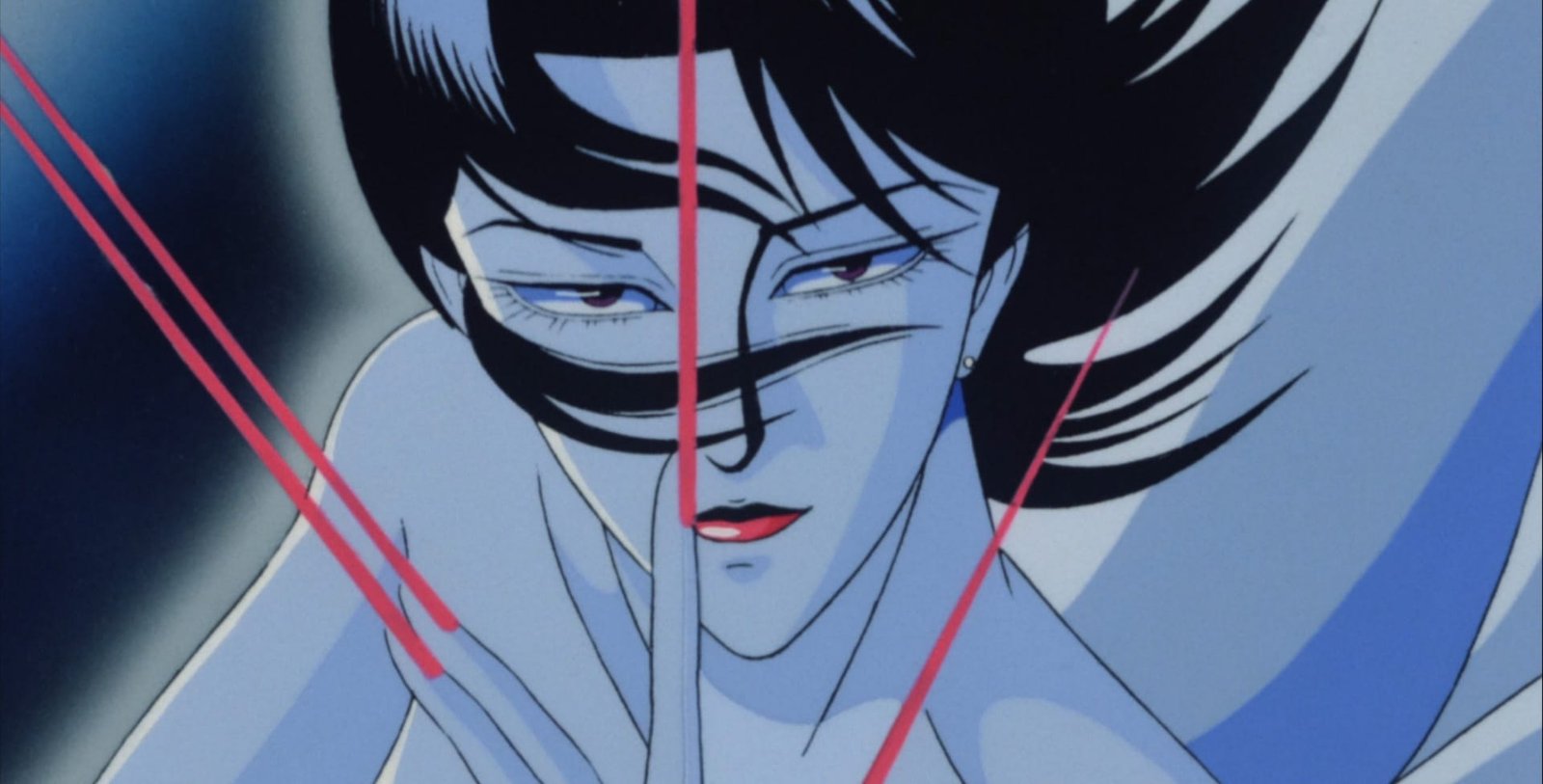
The sexual encounter between the two soon takes a shocking turn as Kanako shows her true form: a demon from the Black World. She metamorphoses into a spider woman, a literal black widow, with the intention of seducing and killing her mate. The encounter with the spider woman pertains to the male libido. She uses Taki’s and his impulse to fulfill a sexual conquest to lure him into a trap. Fortunately, for Taki, she is unsuccessful in bringing about his end. Sigmund Freud would certainly have a field day if he had a few moments to spend with Taki on his couch.
A Partnership, A Comic Relief, and An Escalating Conflict Between Two Worlds
Through Taki’s encounter, we’re introduced to the sexual nature that will be prominent throughout the film. Soon, this gives way to what Taki hinted at in the opening narration: a world that many Tokyo residents are blissfully unaware of. Taki’s internal monologue reveals him to be a member of what’s known as the Black Guard. The group of agents monitors the uneasy alliance between the Black World and humanity. They can be compared to just about any entity that serves as a peacekeeper, from the fictional Men in Black to the CIA.
Taki is assigned to protect Giuseppe Mayart, an ancient prophet who is crucial to fostering a new peace accord between the Black World and human civilization. The uneasy alliance and forthcoming peace talks are under threat from Black World extremists, who are intent on disrupting the hoped-for prosperity.
The protection of Mayart isn’t just Taki’s responsibility. He finds himself paired with Makie, a female Black Guard from the opposing side. The duality of two worlds coexisting is transposed onto the natural dichotomy that exists between male and female. Mayart is the main figure in the upcoming peace agreement; his presence will signal several clashes between Taki, Makie, and Black World radicals. He’s also the film’s comic relief, continually voicing his perverted thoughts in a shrill voice and occasionally acting upon them.

The peace agreement in Wicked City, which represents the fragile alliance between both worlds, can be considered a “MacGuffin.” The preparation for the upcoming event brings the main characters together and sparks conflicts between opposing forces. It’s crucial to the film’s events, yet it becomes something of an afterthought in a web of sexual imagery and fast-paced action sequences.
Despite Mayart having a diplomatic role to fulfil, he’s hampered by his perversions, much to the aggravation of his protectors. The pair struggles to keep him restrained from seeking sexual gratification from some of the bathhouses that exist around Tokyo. Following a showdown at a hotel with a Black World extremist, the prophet escapes from the safehouse in an attempt to fulfil his sexual appetite. As with Taki’s encounter with the spider woman from earlier, another demoness in disguise finds a way to deceive Mayart by taking advantage of his libido and injecting him with a parasite. Taki and Makie soon rescue Mayart and take him to a facility where his health can be restored.
Things take a drastic turn when the parasite within Mayart is vomited up, only to attach itself to Makie. She soon becomes ensnared in a tentacle, leading to a scene of violation. First, from the tentacle itself (a staple of many sexually explicit anime titles) and a group of Black Guard radicals who kidnap her. Shadow, the mysterious leader of the fringe group, uses her abduction to entice Taki to come save her. Makie is reduced to a commodity by the radicals, a means to ensnare Taki in a trap.

There is much to be made regarding the sexually explicit sequences that Makie is subjected to. In fact, the structure of some of them is similar to the Marquis de Sade’s writings. In his book, Justine, or the Misfortunes of Virtue, the titular character is subjected to a never-ending torrent of humiliating and violatory encounters. Justine’s steadfast belief in morality, instilled during her upbringing in a convent, is her downfall. Her desire to do good and be virtuous comes at a price. Even Justine’s death comes as a result of her attempting to do a helpful deed. The torments Makie endures stem from her attempt to do what is right: protect Mayart and ensure the peace conference goes forward. She is violently punished by the radicals who are intent on decimating the hopes for a prosperous future, and what they see as her betrayal of the Black World.
The presentation of sexuality in Wicked City is akin to the narrative structure of Justine, and another one of de Sade’s books, Juliette, or Vice Amply Rewarded. Both texts are rife with sexually explicit material. However, by inflaming the passions of the reader, de Sade grasps their attention to deliver philosophical diatribes. He seizes the opportunity to extoll the advantages of casting aside morality for the sake of personal autonomy. The sexually charged nature of Wicked City ensures that any audience member’s attention remains firmly fixed on the film throughout. Whether or not someone finds the sexual content in Wicked City to be abhorrent, stimulating, or contentious is a matter of subjection.
The intention and depictions of sexuality that exist in Wicked City are varied and are far from one-dimensional. As in the case of Taki and Mayart’s encounters, they represent the impulsive need for gratification and the weakness of libido. In Makie’s ordeals, they exhibit control and subjugation. The film’s climax will depict sexuality’s most basic use, reproduction, which will also establish another point regarding the Cold War.

A Thrilling Climax and Hopes for a Better Future
The climax of Wicked City features elements one might expect from a late-80s anime production. That is to say, frenetic action and what can best be described as a “final boss fight.” Yet it also embodies the wish for a world that looks to the future with optimism. After Makie is rescued by Taki, the two encounter the spider woman from earlier in the film, only for a mysterious force to intervene on their behalf and kill her.
A subsequent scene depicts the pair consummating their relationship. The sexual nature of the scene is presented in a way that highlights intimacy and tenderness, rather than the compulsive and violent aspects that were prominent earlier. Shades of blue highlight the sequence. It’s accompanied by several close-ups of the pair holding hands, a la The Terminator.
As for the MacGuffin from earlier, all is revealed that the real peace accord is the union between Makie and Taki themselves. By bearing Taki’s child, a new generation will secure peace between the two worlds. Mayart is not the one who needs protection. In fact, he has been providing it to the pair in hopes of a future of peace and prosperity. A union between the Black World and humanity is one that Makie will literally give birth to.
The leader of the extremists, Shadow, is defeated by a pregnant Maki, emblematic of blind hatred and chaos failing to overcome the unity between the two opposing sides. Sexuality and the Cold War are usually reserved for a James Bond film. Wicked City seamlessly blends the two together.
A High-Water Mark of Late ’80s Animation
Someone might wonder where Wicked City should reside in the rich pantheon of anime. It would be easy to describe it as a subjective matter regarding personal opinion. Beneath its explicit sexual content and frenetic action, we see art reflecting a time period where the Cold War was still on the minds of many. An uneasy peace will always have detractors and those who are optimistic about the future. Like humanity and the Black World, there will always be two schools of thought: one that might see the film as gratuitous, and another that might regard it as a landmark in animation. Regardless of one’s personal opinion, there’s no denying it’s secured a place in both the history of anime and the annals of transgressive art.
transgressive-sexuality-and-the-cold-war-a-look-back-at-wicked-city